AI Adoption Sprint

Your engineers say they use AI. The velocity says they don’t.
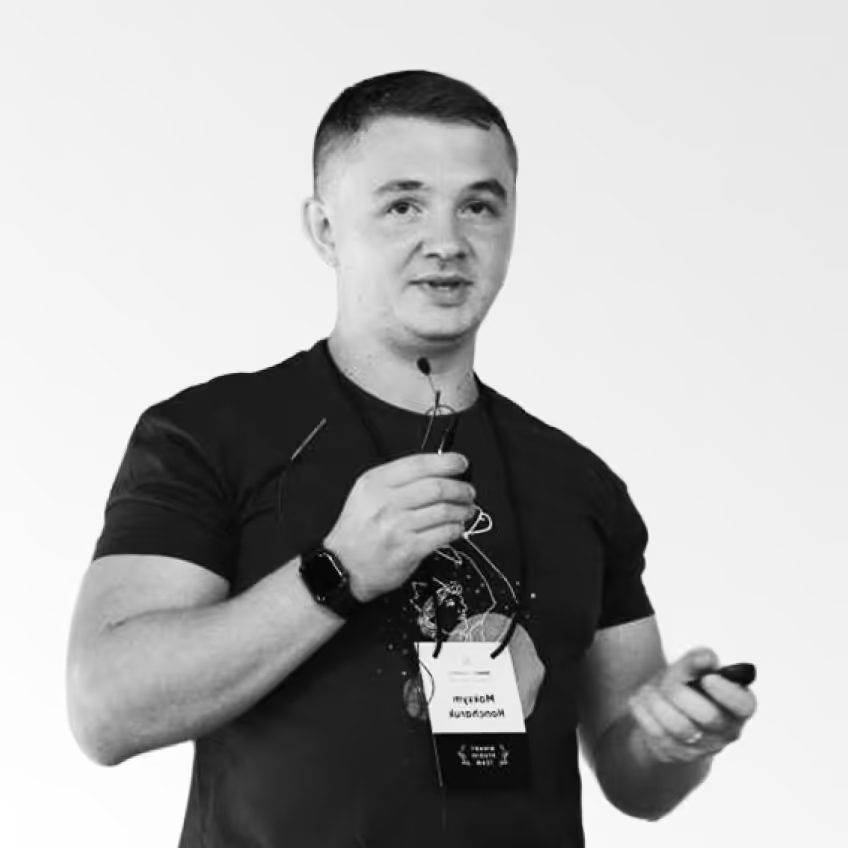
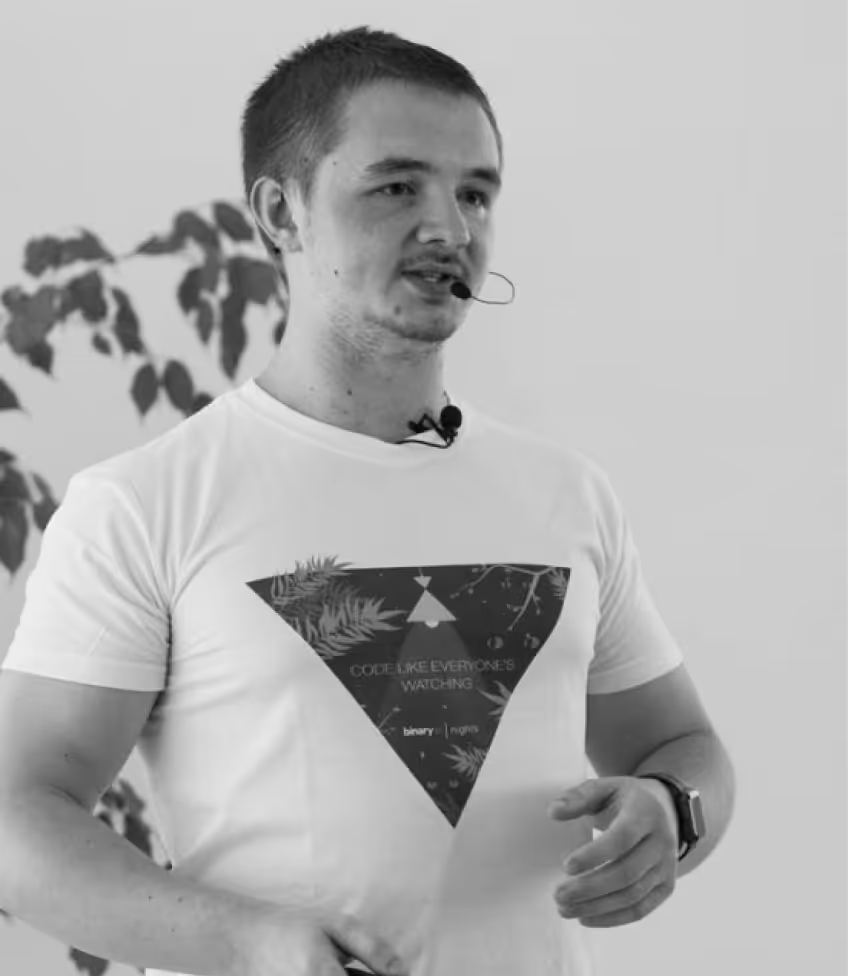
Man in a black t-shirt holding a microphone and a remote, speaking in front of a white background.

Meet Max,
a partner-level solution architect at Radency.

Two years inside 15+ codebases taught me to tell real AI adoption from teams just paying for subscriptions. Over six weeks I work inside your team until the new way of building is a habit.

Why isn't AI making your team dramatically faster?

There are four levels of AI adoption in engineering. Most teams are stuck on the level 0 or 1 and think they're on the second.
Level 0
Powered Autocomplete
Engineers use AI in their IDE for code completion, refactoring, and boilerplate generation. AI is treated as a productivity feature, not an independent agent. The engineer remains fully in control and drives every task.
Level 1
Most teams are here
Prompt-by-prompt
Engineers talk to the agent task by task. Each session starts from scratch — no shared rules, no project memory, no enforced standards. The agent gives an average answer because it sees an average project.
Level 2
Where the shift happens
Context-engineered delivery
The project is documented for the agent, rules per architectural layer, embedded constraints, shared skills. Engineers no longer have to explain the same standards, architecture decisions, and conventions in every session.
What this looks like
On one client's Nest/React stack: 12 layer-specific instruction files written once. Features that took five days now take one. Setup cost: three engineering weeks. Repaid in six.
Level 3
Spec-driven development
Where the industry is heading: You define requirements and use cases, and AI agents build the implementation. We experiment here, but we haven't seen it hold up in production, ours or anyone's. Not something to plan your 2026 around.
Pelico logo.
“We’d spent about a year using AI tools for development but saw no difference in team velocity. Max spent two weeks showing why it wasn’t working and where we should focus. Following the plan step by step, we started seeing progress.”
CEO, B2B SaaS
12 engineers

What Level 1 is costing you

Level 1 Reality
Engineers repeatedly explain the same parts of the codebase to AI
AI output varies wildly between engineers
Senior engineers spend time correcting AI mistakes
Features move a little faster, but not enough to change planning
Level 2 Reality
The codebase, standards, and architecture are already known to the agent
The same prompt from a junior and a senior produces code that passes the same review.
Seniors focus on architecture and review, not rework
A feature that took five days gets done in one.

Why adoption stalls even when everyone agrees AI matters

Your engineers aren't scared AI will replace them. They just don't want to complicate a workflow that already feels fine.
Juniors

They may ship fast with AI, and you have no idea if any of it is solid. The output looks great in the demo. You find out months later what it cost you.

Mid-levels

Your most productive engineers are the ones most sure they don't need to change. They're fast, so they tune out the thing that would make the whole team faster.

Seniors

The person whose opinion your team trusts most is the one most against it. Modern frameworks, clean modules, documented interfaces. Easier to hire into, easier to ramp up, easier to retain.

Founder

You paid for the tools. Nothing changed, and you can't tell whose fault that is, the tools, the team, or the fact that nobody owns making it work.

What 6 weeks inside your team changes

The tools you bought don't change habits on their own. Six weeks of working alongside your team does. Here's what each part looks like.
First, we find the bottlenecks
  • Sitting in on stand-ups and watching how your engineers actually use the tools, not what they say in the daily.
  • Reading your codebase the way an agent reads it. I talk to people separately, including the sceptic. No slides, no homework for your team. Just observation.
Then we build the context layer
  • Mapping your team's real level, layer by layer, and naming the 3 to 5 things blocking the next one.
  • Then a 30-day plan: which context files to write, in what order, who owns each, what changes in week one versus week four. Specific enough that your team can start preparing them immediately.
Then we embed it into daily work
  • Four weekly working sessions with your team.
  • Review what they worked on that week, read the prompts that worked and the ones that didn't, fix what's breaking, and figure out what else AI can help with.
The results
  • Your engineers prompt with the codebase's real context.
  • Your seniors stop fighting the tools and start directing them.
  • The features stalled start moving.
  • You stop wondering whether AI is helping, you can see where it is and isn't, and so can your team.

If implementation is needed

If the plan calls for it, Max with the Radency team:
  • writes the context layer with you
  • the layer-specific instruction files
  • the rules
  • the MCP integrations, so your codebase is properly documented for the agent, not patched together ad-hoc.

Max stays involved to keep the structure honest; the build is the team's.
Max giving a presentation with a microphone.

Trusted by the top tech leaders from

Smiling bald man with light facial hair wearing a black shirt against a plain light background.
If you have more engineers like this, I'll make space for them.
Engineering Manager @ n8n
Logo with two stylized human figures standing side by side, one in pink and one in teal.
n8n logo with connected nodes representing automation workflows.
Smiling bald man with light facial hair wearing a black shirt against a plain light background.
If you have more engineers like this, I'll make space for them.
Engineering Manager @ n8n
Logo with two stylized human figures standing side by side, one in pink and one in teal.
n8n logo with a stylized branching node diagram.
Smiling bald man with light facial hair wearing a black shirt against a plain light background.
If you have more engineers like this, I'll make space for them.
Engineering Manager @ n8n
Logo with two stylized human figures standing side by side, one in pink and one in teal.
Logo of the brand AIRDNA with modern, stylized gray letters on a light background.
Smiling bald man with light facial hair wearing a black shirt against a plain light background.
If you have more engineers like this, I'll make space for them.
Engineering Manager @ n8n
Logo with two stylized human figures standing side by side, one in pink and one in teal.
Pelico company logo with stylized design element to the left of the text.
Smiling bald man with light facial hair wearing a black shirt against a plain light background.
If you have more engineers like this, I'll make space for them.
Engineering Manager @ n8n
Logo with two stylized human figures standing side by side, one in pink and one in teal.
Jump logo with a large dot and two smaller dots to the left of the word 'Jump' in gray on a white background.
Smiling bald man with light facial hair wearing a black shirt against a plain light background.
If you have more engineers like this, I'll make space for them.
Engineering Manager @ n8n
Logo with two stylized human figures standing side by side, one in pink and one in teal.
Salesforce company logo with text inside a cloud shape.
Smiling bald man with light facial hair wearing a black shirt against a plain light background.
If you have more engineers like this, I'll make space for them.
Engineering Manager @ n8n
Logo with two stylized human figures standing side by side, one in pink and one in teal.
Cisco company logo with stylized vertical bars above the company name.
Smiling bald man with light facial hair wearing a black shirt against a plain light background.
If you have more engineers like this, I'll make space for them.
Engineering Manager @ n8n
Logo with two stylized human figures standing side by side, one in pink and one in teal.
Stripe logo in gray text on a white background.
Smiling bald man with light facial hair wearing a black shirt against a plain light background.
If you have more engineers like this, I'll make space for them.
Engineering Manager @ n8n
Logo with two stylized human figures standing side by side, one in pink and one in teal.
Twilio logo with a four-dot circular icon to the left of the company name.
Smiling bald man with light facial hair wearing a black shirt against a plain light background.
If you have more engineers like this, I'll make space for them.
Engineering Manager @ n8n
Logo with two stylized human figures standing side by side, one in pink and one in teal.
DHL company logo with stylized letters and horizontal speed lines on a light background.
Smiling bald man with light facial hair wearing a black shirt against a plain light background.
If you have more engineers like this, I'll make space for them.
Engineering Manager @ n8n
Logo with two stylized human figures standing side by side, one in pink and one in teal.
AstraZeneca logo.
Show more
Pelico logo.
“The thing that surprised me was how much of it was just writing stuff down. We thought we had an AI problem. Turned out half of it was that nobody had documented how anything worked, so the AI was guessing. Once we fixed that, the difference was obvious.”
Founder, vertical SaaS
5 engineers

Partner-level Solution Architect

Portrait image for a Radency client review.
12 years building engineering teams, leading AI-augmented delivery at Radency. Max developed the framework on AI-fluency assessment and adoption in engineering teams. He's the one watching how your team actually works, and the one writing the assessment.
Max
Partner & Solution Architect at Radency
Pelico logo.
“It's hard to point at one number. The team just works differently now. A feature that would've been a week is a couple of days, and I'm not the one chasing people to use the tools anymore, they figured out where it helps and where it doesn't on their own.”
Head of Product
Marketplace platform, 14 engineers

Find out what level your team is actually operating at

Max Honcharuk
Partner & Solution Architect
Radency project image.

FAQ

01
How do you protect our code?

We work under your NDA, on your access controls. We don't take copies home. If you have a SOC 2 environment, we operate inside it.

02
Will my engineers see this as a threat?

If you frame it as a layoff prelude, yes. If you frame it as us helping the team work better with tools they already have, no. We help you with the framing before week 1 starts.

03
What does it actually cost?

Diagnostics run $12k to $18k depending on team size and codebase complexity. We quote on the qualifying call after we understand your situation.

04
What if you find out we don't need this?

If we conclude in the first three days that a diagnostic won't help you, we end the engagement and refund the balance, minus a cost-of-time fee.

05
Can we start next week?

Usually yes, most engagements begin within 10 working days of the qualifying call. We run a limited number of diagnostics per quarter and book in order.